
Challenge type: Binary Secrets · Difficulty: ★★★★☆ Tricky · Code: ASCII, 8 bulbs per character
Each row of bulbs is one letter. Add up the numbers above the bulbs that are switched on.
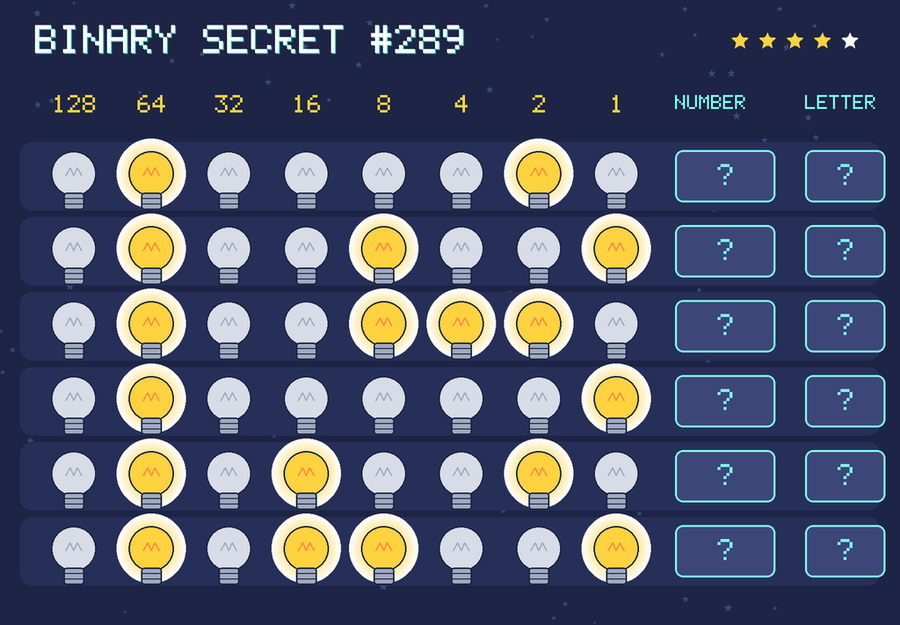
The secret is a word with 6 letters.
The bulbs as 1s and 0s
 1:  0 1 0 0 0 0 1 0
 2:  0 1 0 0 1 0 0 1
 3:  0 1 0 0 1 1 1 0
 4:  0 1 0 0 0 0 0 1
 5:  0 1 0 1 0 0 1 0
 6:  0 1 0 1 1 0 0 1
How to crack it
This message uses the same code real computers use for letters (it’s called ASCII). Each character is 8 bulbs, and the bulbs are worth 128, 64, 32, 16, 8, 4, 2 and 1.
| Characters | Numbers |
|---|---|
| A to Z | 65 to 90 (A is 65, B is 66, and so on) |
| a to z | 97 to 122 (a is 97, b is 98, and so on) |
| space | 32 |
| ! | 33 |
| ‘ (apostrophe) | 39 |
Need a hint?
The first row is 01000010. 64 + 2, which makes 66. Which letter is that?
For teachers and grown-ups
Skills practised: Number representation, place value in base 2, and encoding information.
The big idea: Computers store everything, including text, as patterns of 1s and 0s.
Questions to ask:
- Why does each bulb’s value double as you move left?
- What is the biggest number 5 bulbs can show? What about 8?
- Why might computers use 8 bits for each letter?
Take it further: Children encode a short message for a partner using paper bulbs, coloured beads or claps and pauses.