Track: Robots & Electronics · Lesson 1 of 10 · Ages: 7+ · Time: 30 minutes
Quick question: is a toy car a robot? What about a robot vacuum cleaner that scoots around the floor by itself? Today you will learn a simple test that tells you the answer every time.

Beep says Hello, I am Beep! I am a robot, and I follow a secret with three steps. By the end of this lesson, you will know it too. Beep boop!
What you need
- A pencil and some paper.
- A grown-up or a friend to play a game with.
- About half an hour.
Grown-ups No electronics today. This lesson builds the big idea that the whole track uses: a robot senses, thinks and acts. You can help by pointing out machines at home and asking “what does it sense?” and “what does it do?”. There are no wrong guesses, only good conversations.
The secret: sense, think, act
A robot is a machine that can notice what is happening around it, decide what to do, and then do it, with no person steering it moment by moment. That gives us three steps:
- Sense. The robot collects information using parts called sensors. A sensor is like a robot’s eyes, ears or skin.
- Think. The robot’s tiny computer follows a program, which is a list of instructions. The program chooses what to do.
- Act. The robot does something using parts like motors, lights or speakers.
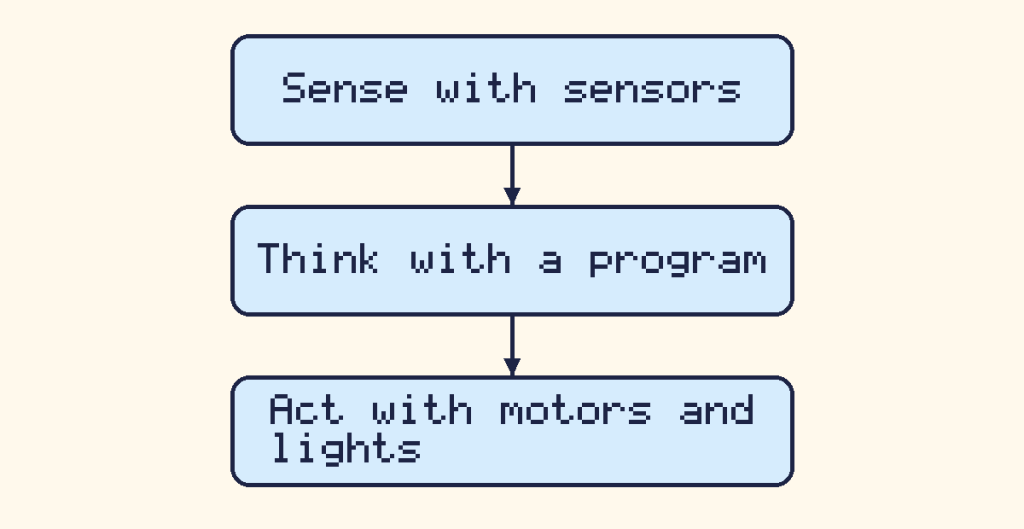
Then the robot does it all again, many times every second. This is called the sense-think-act loop.
Is it a robot?
Let us test some machines with our three steps.
| Machine | Sense | Think | Act | Robot? |
|---|---|---|---|---|
| Robot vacuum | Bump and floor sensors | Picks a new direction | Wheels and brushes | Yes! |
| Remote-control car | None | You do the thinking | Wheels | No, you are the brain |
| Bicycle | None | You do the thinking | Wheels | No, no program at all |
| Night-light that switches on in the dark | Light sensor | If dark, switch on | Light | A very simple robot-like machine |
The remote-control car is a good one to think about. It has motors and wheels, but a person senses and decides everything. The car just obeys. A car that can drive itself, noticing the road and choosing where to go, would be a robot.
Pixel says Some machines sit in the middle, and that is fine! Grown-ups argue about where to draw the line too. The more a machine senses and decides for itself, the more robot-like it is. Meow!
Make a human robot
Time to play the three steps yourself. This game is for two people, in a clear space, with slow and careful steps. No running!
- One person is the robot. The other is the world.
- The world holds up a card with a picture or colour on it: green or red.
- The robot senses it by looking. The robot thinks about this rule: if green, take one slow step forward. If red, stay still.
- The robot acts by following the rule exactly.
Play ten rounds and swap. Notice how the robot never needs anyone to say “go” or “stop”. The card and the rule do all the work.
Robot decisions in Python
Python can pretend to be a robot brain. Here, a robot gets distance readings, in centimetres, from a sensor that looks forward. The rule is: if something is closer than 10, stop.
distances = [50, 30, 12, 8]
for distance in distances:
    if distance < 10:
        print(distance, "-> too close! Stop.")
    else:
        print(distance, "-> clear. Keep going.")
50 -> clear. Keep going. 30 -> clear. Keep going. 12 -> clear. Keep going. 8 -> too close! Stop.
Each time round the loop, the robot senses (reads a distance), thinks (the if) and acts (prints what it would do). The word if is how a program makes a decision. You will use it a lot in this track.
Did you know? The word “robot” first appeared in a play written in the 1920s by a Czech writer named Karel Capek. It comes from a Czech word for hard work. Robots have been helping with hard work ever since!
Challenges
Try it Change the rule in the Python program so the robot stops when something is closer than 20. Which readings now say “Stop”?
Show the answer
Change 10 to 20 in the if line. Now only the 12 and the 8 are closer than 20, so those two readings say “too close! Stop.”
distances = [50, 30, 12, 8]
for distance in distances:
    if distance < 20:
        print(distance, "-> too close! Stop.")
    else:
        print(distance, "-> clear. Keep going.")
Try it Walk around your home with a grown-up and find three machines. For each one, say what it senses, what it thinks and what it does. Is it a robot, or just a machine?
What you learned
- A robot senses, thinks and acts, without a person steering every move.
- Sensors gather information, a program makes decisions and motors, lights or speakers do the acting.
- A remote-control car is not a robot, because a person does the sensing and thinking.
- In Python,
iflets a program make a decision.