Track: Unplugged · Lesson 6 of 10 · Ages: 7+ · Time: 40 minutes
Computers do not understand letters, pictures or music. Deep inside, they only understand two things: on and off. Yet they can show you a film! How? By using clever codes made from just those two choices.
Today you will write a word using only two colours of beads. You will make a code bracelet that a friend can read!

Beep says My brain is full of tiny switches. Each switch is either on or off, like a light bulb. A lot of switches in a row can hold a lot of information. Beep boop!
What you need
- Two colours of beads, such as blue and yellow. Or two colours of felt-tip pen and a paper strip.
- String or stretchy cord.
- Scissors, used by a grown-up or with a grown-up nearby.
- Paper and a pencil.
Safety first Beads are small parts. Keep them away from babies and toddlers under 3, and do not put beads in your mouth. Ask a grown-up to cut the string and tie the knots. Make the bracelet loose enough to slip off easily. Never eat anything you used in an activity.
Grown-ups This activity introduces binary, the base-2 number system that computers use. You do not need to explain place values in depth. The pattern of 16, 8, 4, 2, 1 does the work. If you do not have beads, colour in a strip of squares, or use two colours of sticker. Check your child’s answers against the cheat sheet, which is hidden in Step 5.
Step 1: two colours make a code
A bit is a single choice with two options. We will call the blue bead 0 and the yellow bead 1. (A computer would say off for 0 and on for 1.) A group of bits in a row is a binary number. “Bi” means two.
Step 2: give every letter a number
We number the letters of the alphabet: A is 1, B is 2, C is 3, and so on until Z is 26.
To write a number with beads, we use five beads in a row. Each bead place is worth a different amount. From left to right, they are worth 16, 8, 4, 2 and 1. A yellow bead means “add this amount”. A blue bead means “add nothing”.
The letter F is number 6. We need 4 + 2 = 6. So we use yellow for the 4 and the 2, and blue for all the others:

Five beads are enough, because the biggest pattern is yellow in all five places, which is 16 + 8 + 4 + 2 + 1 = 31. That is more than the 26 letters we need.
Step 3: how to work out the beads
Take the letter S. It is the 19th letter. Go along the places from the left:
- Is 19 at least 16? Yes! Yellow. 19 – 16 = 3 left.
- Is 3 at least 8? No. Blue.
- Is 3 at least 4? No. Blue.
- Is 3 at least 2? Yes! Yellow. 3 – 2 = 1 left.
- Is 1 at least 1? Yes! Yellow. Nothing left.
That gives 1 0 0 1 1, or yellow, blue, blue, yellow, yellow.
Step 4: code a word
Let’s code Pixel’s favourite food: FISH.

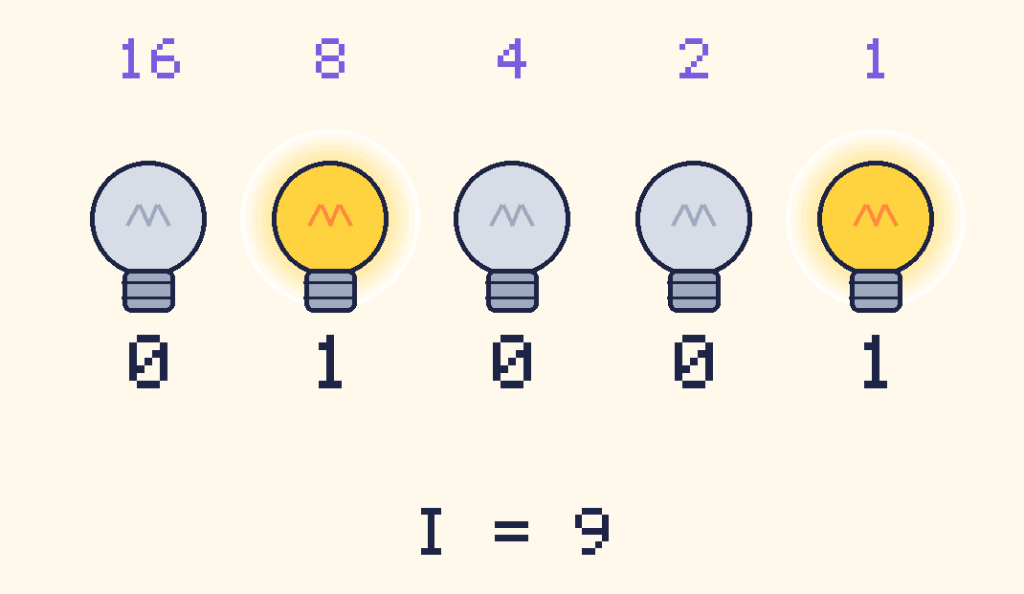
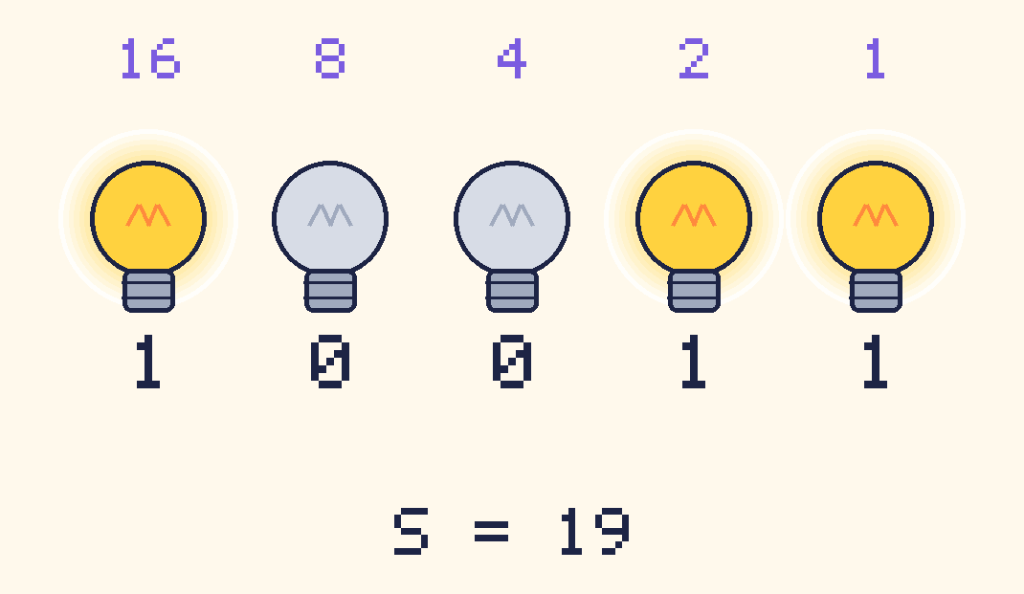

Written as numbers, FISH is 00110 01001 10011 01000. That is 20 beads. Thread the beads in order, and tie a knot between each letter (every 5 beads) so a friend knows where each letter stops. Use your favourite word, or your pet’s favourite food. Short words of 3 to 5 letters work best.
Pixel says Fish! My favourite word. It only takes 20 beads. Meow!
Step 5: crack a bracelet
Swap bracelets with a friend and decode them. Read each group of 5 beads from the left. Add up the places that are yellow. Then turn the number back into a letter.
Show the cheat sheet
A =  1 = 00001      B =  2 = 00010
C =  3 = 00011      D =  4 = 00100
E =  5 = 00101      F =  6 = 00110
G =  7 = 00111      H =  8 = 01000
I =  9 = 01001      J = 10 = 01010
K = 11 = 01011      L = 12 = 01100
M = 13 = 01101      N = 14 = 01110
O = 15 = 01111      P = 16 = 10000
Q = 17 = 10001      R = 18 = 10010
S = 19 = 10011      T = 20 = 10100
U = 21 = 10101      V = 22 = 10110
W = 23 = 10111      X = 24 = 11000
Y = 25 = 11001      Z = 26 = 11010
Challenges
Try it Decode this bracelet. Blue is 0 and yellow is 1: 00100 01111 00111. What word is it?
Show a hint
Work out each group on its own. The first group has a yellow bead only in the 4s place, so it is the number 4. Which letter is the 4th?
Show the answer
00100 is 4, which is D. 01111 is 8 + 4 + 2 + 1 = 15, which is O. 00111 is 4 + 2 + 1 = 7, which is G. The word is DOG!
Try it Write the word BEEP in beads.
Show the answer
B is 2: 00010. E is 5: 00101. E is 5 again: 00101. P is 16: 10000. Altogether: 00010 00101 00101 10000.
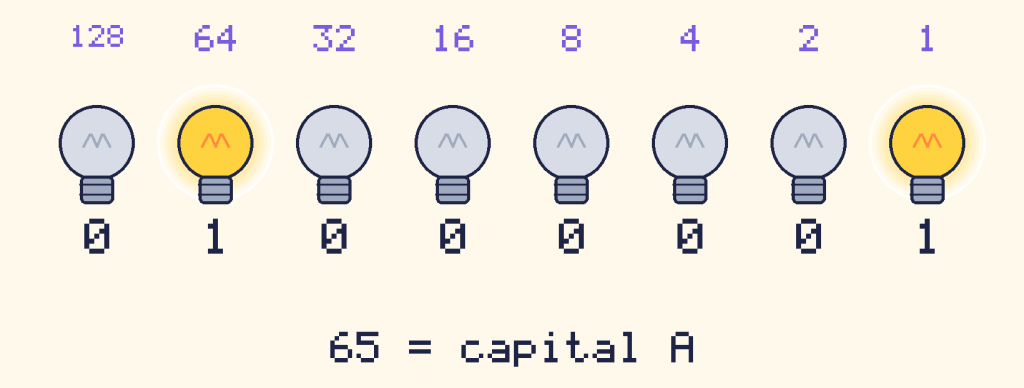
Did you know? Real computers use longer codes, often 8 bits, so that they can also store capital and small letters, numbers and symbols. Many computers store a capital A as the number 65, which is 01000001 in eight bits:
What you learned
- A bit is a choice between two things, like 0 and 1 or off and on.
- A row of bits is a binary number. Each place is worth 16, 8, 4, 2 or 1 in a five-bit code.
- Letters can be turned into numbers, and numbers into bits, so a computer can store words.
- Five bits give 32 different patterns, which is plenty for the 26 letters.